

Accelerate the Success of your New Business.
Learn the common challenges and capitalize on the opportunities that both new business and growing companies will encounter.
Date Published: November 23, 2023 | Update: Jan. 22, 2026
Authored by H.J.Schmitt, SCMP
S&Co., Supply Chain Logistics Consulting
SUBSCRIBE HERE.
The Resilient Scale-Up.
Navigating the Barriers to Resilience: Before a company can scale, it must survive these “New Business Strength” factors. These aren’t just hurdles; they are the stress tests that define your market position.

Factors Effecting New Business Strength.
Understand the common challenges for new market entrants and growing companies often encounter on the pathway to scaling up. Opportunities exist for savvy business leaders when they know the risks of ignoring realities of competitive markets and not all of them are obvious.
Positive Factors for Strength through Innovative Environments
High Entry Costs
- New businesses often face high start-up costs. These can include costs for product development, testing, marketing, and distribution.
Competitive Reaction
- Existing businesses may react strongly to new entrants, leading to price wars or intense marketing campaigns.
Customer Loyalty and Brand Recognition
- Established companies often have loyal customers and strong brand recognition, which can be difficult for new entrants to overcome.
Regulatory Restrictions
- Some industries have governmental regulations that can make it difficult for new companies to enter the market.
Access to Distribution Channels
- Established companies often control the most efficient distribution channels, which can be a barrier for new entrants.
Economies of Scale
- Larger, established companies can produce goods and services more cheaply due to economies of scale, putting new entrants at a disadvantage.
Lack of Resources
- New entrants may lack the necessary resources —financial, human, or physical— to compete effectively.
Technology and Expertise
- New entrants can face difficulties if they lack specific technologies or expertise needed in the industry.
Market Saturation
- If the market is already saturated, it can be difficult for a new business to carve out a share of the market.
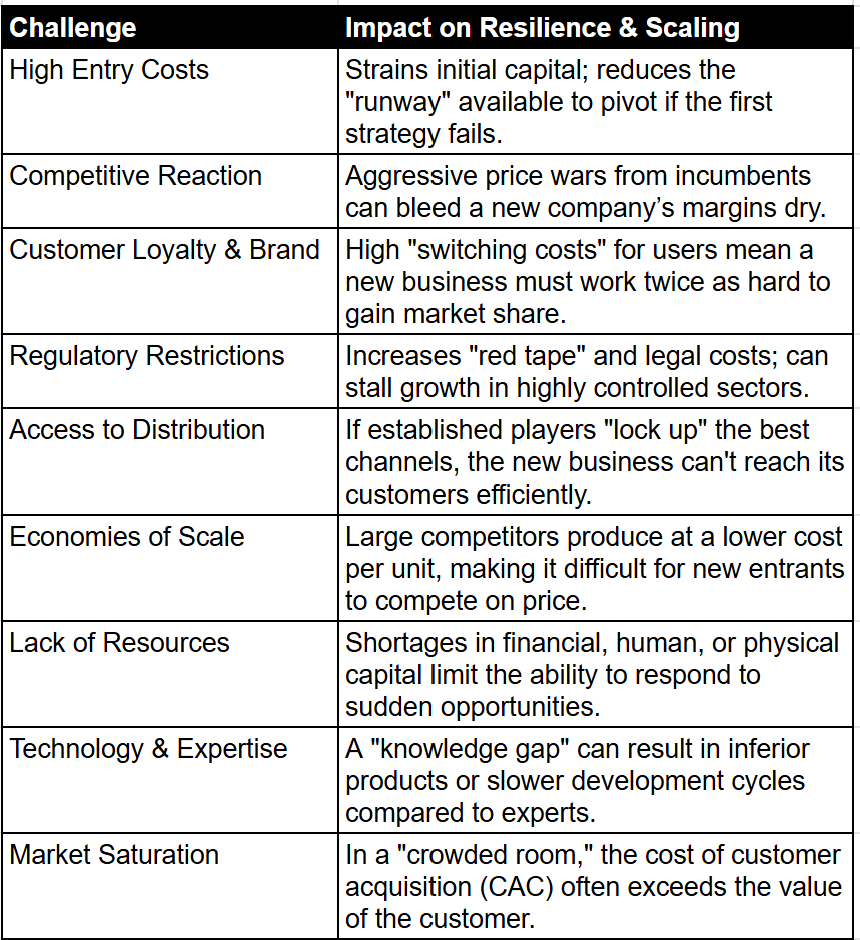
These challenges can vary depending on the specific market and industry.
The Opportunity.
Innovation and Internal Communications for Business Success.
Established businesses, startups, and expanding companies, can nurture an innovative culture and capitalize on the opportunities they present.
The Resilience “Triple Threat”
The journey to a resilient scale-up is fueled by three specific internal investments. These create a inpenetrable moat that protects your company when external factors – like competitive reaction, and your teams responsiveness to them – are lagging behind.
A. Research and Development (R&D). Investing in innovation ensures you aren’t just copying existing players. It allows you to bypass customer loyalty barriers by offering something that other incumbents cannot provide.
B. Effective Internal Communications. Resilience requires agility. If your team is siloed, they cannot pivot quickly. Open channels ensure that customer loyalty and competitive reaction data from the field reaches decision-makers in real-time.
C. Ongoing Employee Development. A diversified workforce and ongoing continual learning prevent intellectual stagnation. When the market shifts, a skilled workforce can adapt their expertise to new technologies or distribution channels.
Key Takeaway: Resilience isn’t just the ability to bounce back; it’s the ability to evolve forward. By investing in your people and your processes early, you turn the “High Entry Costs” into a long-term competitive advantage.

Transforming Culture into a Strategy
Resilience is a byproduct of processes, policies, technology and people – in other words, your corporate culture. To move from a fragile startup to a resilient scale-up, you can review these “simple pointers” to understand your businesses readiness to adapt to external pressures through responsive and innovative people.
-
Normalize Failure: By “Celebrating Learning from Failure,” you reduce the fear that prevents employees from taking the risks necessary to overcome “Market Saturation.”
-
Decentralize Ideation: Use “Freethinking” and “Collaboration” to solve the “Lack of Resources” problem—your people are your most creative resource.
-
Leadership Alignment: Leaders must not only fund innovation but “lead by example” to ensure these values stick during high-pressure scaling phases.
The Innovative Culture Checklist:
Identify where your organization practices these core concepts or start by bringing them into your company or team culture today. Does it feel like you are falling behind? We can help you with that. Our change management support for improving your organizational reslilience and streamlining operational flow is here for you. Apply for your free consultation and learn how our dedication to your success is an effective catalyst to bring about positive and lasting change.
Encourage Freethinking:
- Encourage employees to think outside the box and reward innovative ideas. This creates an environment that values experimentation and risk-taking.
Employ a Diversified Workforce:
- A diverse workforce brings a variety of perspectivesand talents, which can lead to unique solutions and breakthrough ideas.
Offer Continual Learning:
- Promote an environment that values skill and knowledge expansion. This can be facilitated through training programs, workshops, and regular industry updates.
Keep Open Communication Channels:
- Encourage open communication and the sharing of ideas across all levels of the organization.
Continue to Invest in Innovation:
- Allocate resources specifically for innovation, such as time for ideation, tools, and technology.
Encourage Collaboration:
- Promote team collaborations as they often generate creative solutions and innovative ideas.
Celebrate Learning from Failure:
- Treat failures and mistakes as learning opportunities rather than setbacks, which fosters risk-taking and innovation.
Demonstrate Leadership Commitment:
- Leaders should actively support and drive the culture of innovation forward by leading by example.
Strategic Countermeasures
Building an Innovation Culture will counteract the negative pressures your teams experience and helps to embed agility into the people of the organization. This flexibility and drive for innovative solutions serves as the “engine” that powers companies through the friction of the market during scale-up cycles.
How to Capitalize on the Opportunity
To turn these challenges into strengths, focus on intellectual agility, structural openness, and sustainable growth. By encouraging freethinking and diversifying the workforce, you generate unique solutions that established, more rigid competitors, might overlook.Continual learning and investing in innovation ensure that as your business scales up, your team’s expertise grows faster than the complexity of the market. Remember that companies that celebrate learning with failures develop a psychological safety that allows them to experiment with new distribution channels, and technologies, without the paralyzing fear of a setback.
[1] T. S. Oliveira, C. Borges and M. Caetano, “Return on investing in innovative activities: the brazilian manufacturing industry”.

