
Elements of Negotiation | Back to Basics
The important things that you should know before your next negotiation.
Posted November 15, 2023 | Updated March 22, 2026
By Hilary J. Schmitt, BBA, SCMP
S&Co., Supply Chain Logistics Consulting
SUBSCRIBE HERE.
Everyone negotiates — constantly, and often without realizing it. This guide is for the times when you need to approach an agreement with intention, preparation, and a clear strategy.
Elements of a Purposeful Negotiation
“Preparation does not mean predicting every outcome. It means knowing exactly what you need, what you can concede, and what you will do if agreement is not possible.”
Negotiation happens in nearly every part of business — supplier contracts, team decisions, budget conversations, partnership terms, and client agreements. Many leaders navigate these moments on instinct, and that works up to a point. But when the stakes are high and the outcomes matter, instinct alone is not a strategy.
This article walks through the key elements of negotiation preparation: what to think through before you sit down, how to stay focused during the process, and how to close — or walk away — with confidence. Use it as a readiness checklist, a team discussion guide, or a reference ahead of your next significant agreement.
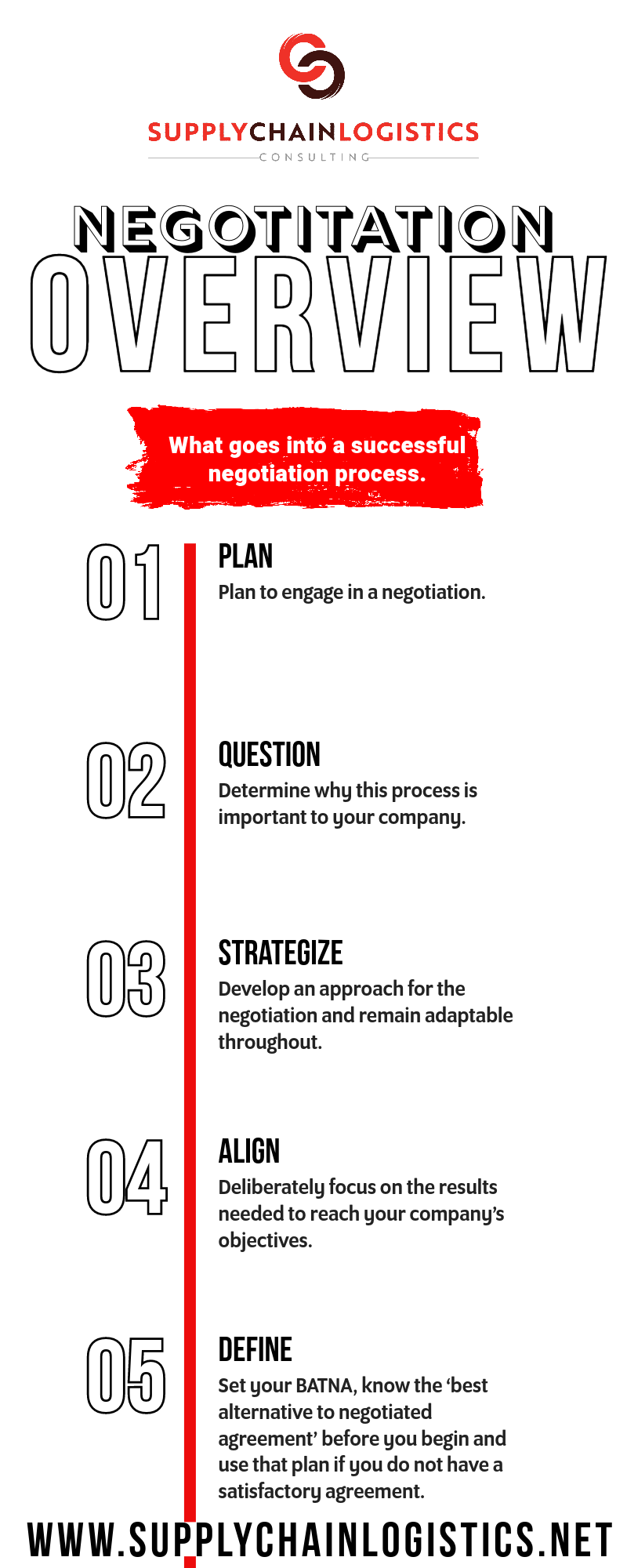
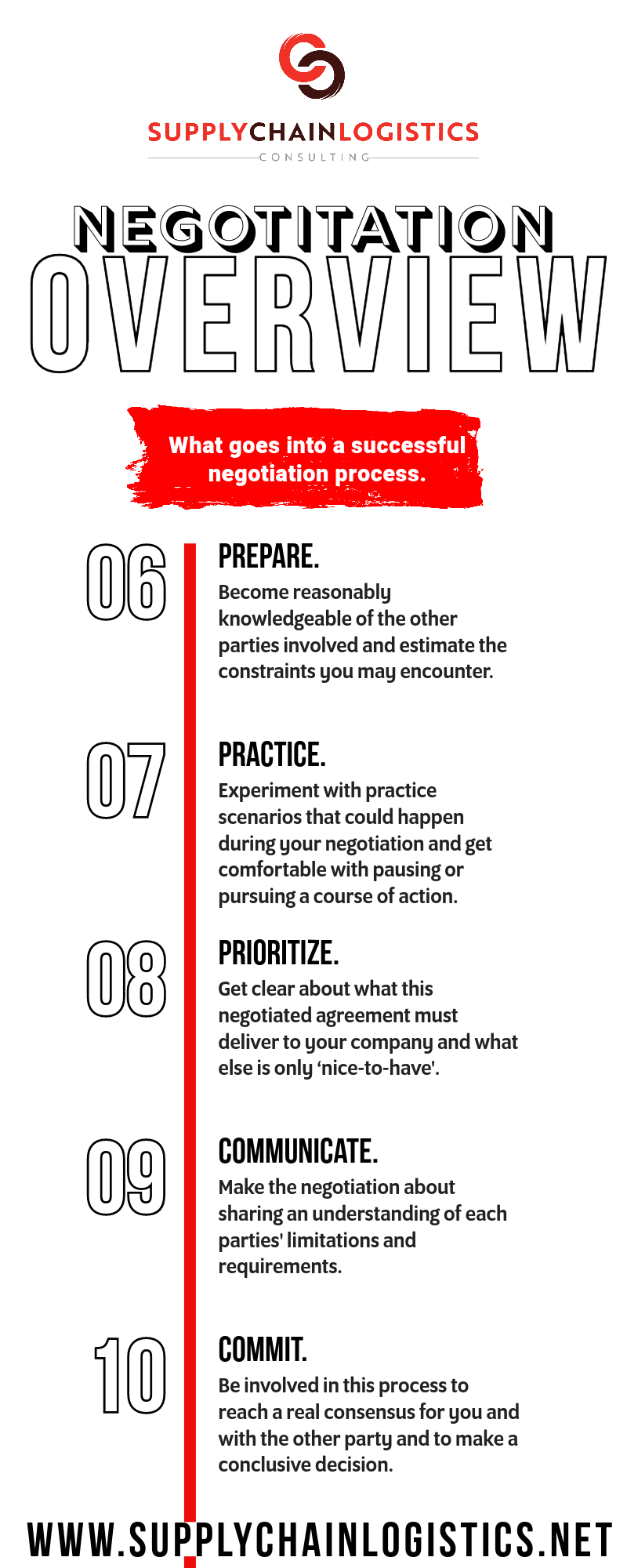
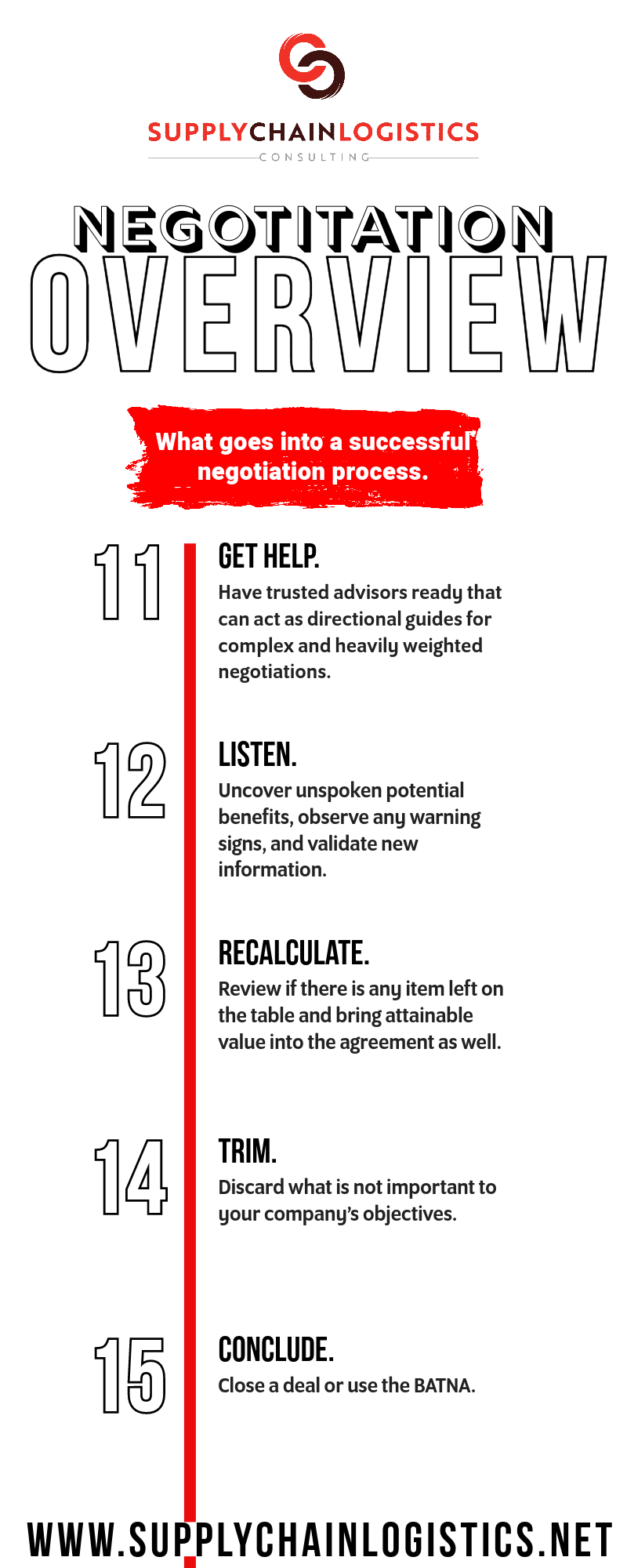
15 Elements to Know Before You Negotiate
These steps are not a rigid sequence — they are a preparation framework. Some will take minutes; others deserve hours of focused thinking. Read through the full list, then use the self-assessment below to gauge your readiness honestly.
SELF ASSESSMENT
Negotiation Readiness
You have reviewed the checklist. Now answer this single question honestly — your answer will tell you more about your readiness than any score.
Select the statement that best describes where you are right now
A. I have the right amount of information and feel confident I can reach an acceptable agreement.
B. I still have too much to think through — things may move quickly and I want to be better prepared.
C. I do not need to prepare. I negotiate all the time and I know what I am doing.
How did you do?
Did you say you are… A) adept, B) unprepared, or C) overconfident.
WHEN NEGOTIATIONS STALL
Meditation
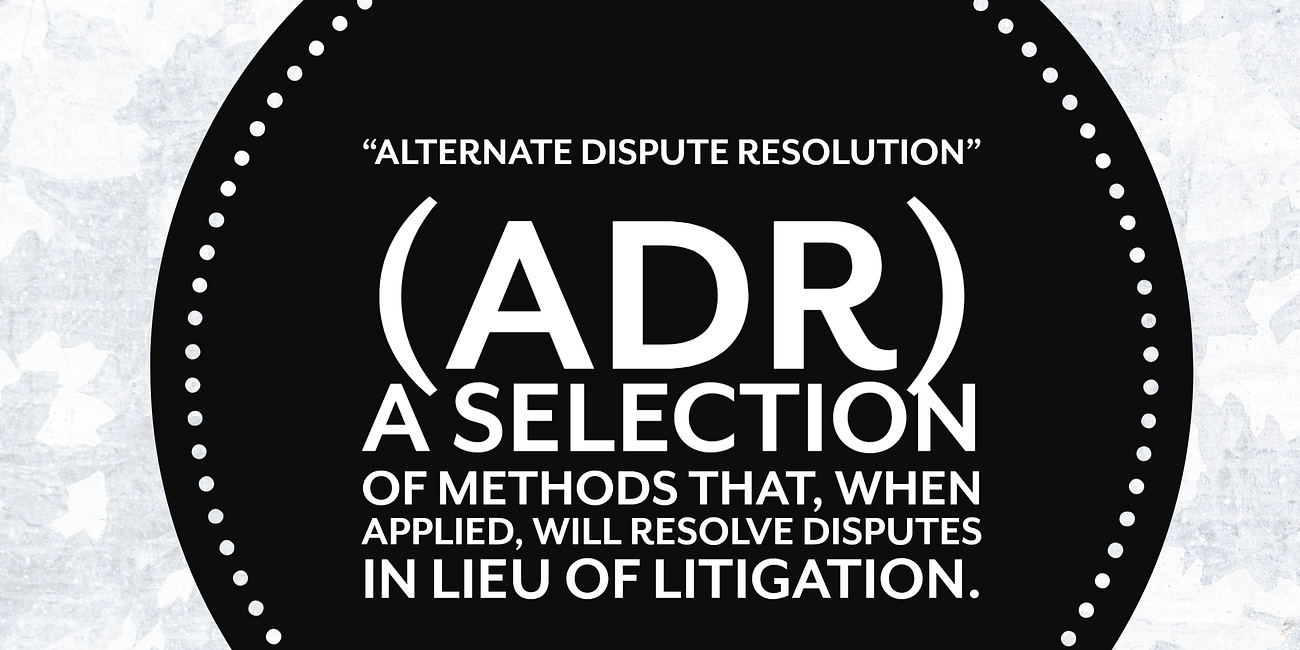
When parties reach an impasse, bringing in a neutral third party can unlock what direct negotiation cannot. Mediation is the most common form of Alternative Dispute Resolution (ADR) used in commercial and supply chain contexts — and there are two meaningfully different roles a mediator can play.
ADR: Alternative Dispute Resolution.
Alternative Dispute Resolution – Supply Chain Logistics Consulting
The distinction matters when selecting a mediator for a dispute. If the relationship between parties is the priority, facilitative mediation preserves it better. If a binding outcome is needed quickly, evaluative mediation accelerates resolution. In complex commercial disputes, both approaches may be used in sequence.
For a deeper treatment of integrative negotiation strategies — approaches designed to expand the value available to all parties rather than simply dividing a fixed amount — see The Four Benefits of Integrative Negotiations below.
Mediation Role 1; Facilitative
- Focuses on improving communication between parties
- Ensures each side is genuinely heard and understood
- Guides the conversation toward productive outcomes
- Does not evaluate positions or propose settlements
(2022, Collaborative article by HBR Program on Negotiation Staff, https://www.pon.harvard.edu/daily/mediation/alternative-dispute-resolution-adr-and-negotiations-negotiating-for-the-right-mediator/)
Mediation Role 2; Evaluative
- All tasks of a facilitative mediator
- Also assesses the positions of each party
- May predict how an arbitrator would likely rule
- Can propose a settlement for the parties to consider
(2022, Collaborative article by HBR Program on Negotiation Staff. https://www.pon.harvard.edu/daily/mediation/alternative-dispute-resolution-adr-and-negotiations-negotiating-for-the-right-mediator/)
Negotiation is one of the highest-leverage skills in business — and one of the most consistently under-prepared for. The leaders who do the work ahead of time — who know their BATNA, their priorities, and the constraints of the other party — are the ones who close better agreements, build stronger relationships, and walk away from bad deals before they become costly ones.
Back-to-Basics:“The Benefits of Integrative Negotiations”
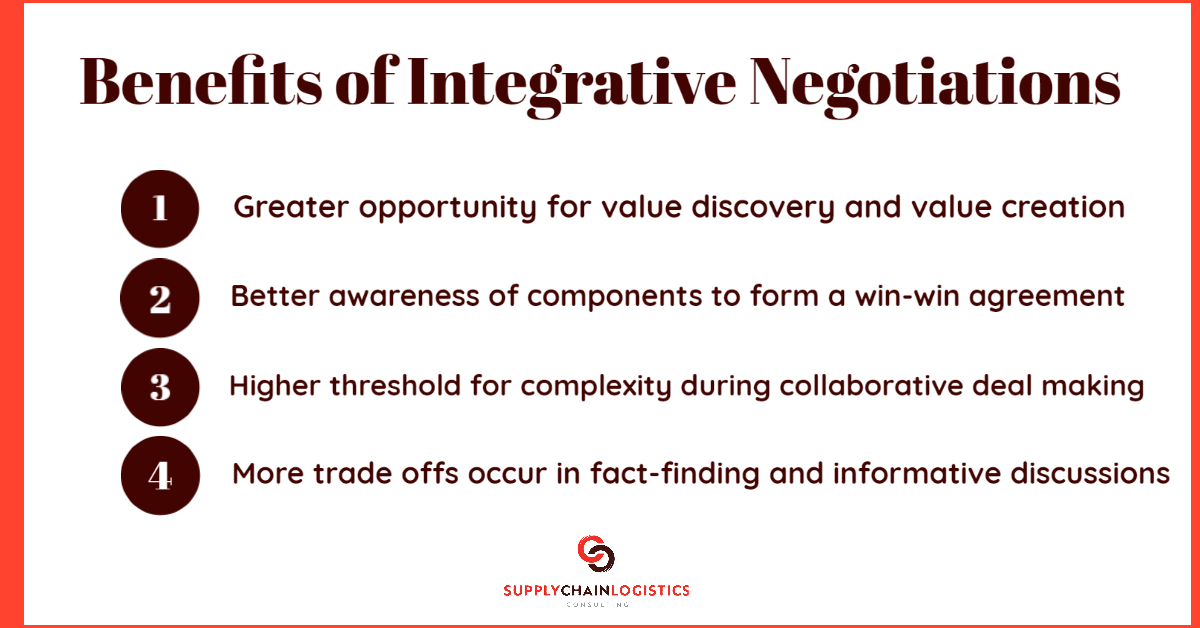
The Four Benefits of Integrative Negotiations. (SupplyChainLogistics.net)
At S&Co., Supply Chain Logistics Consulting Inc., we work with business leaders to prepare for complex commercial negotiations, assess existing supplier agreements, and facilitate resolution when agreements break down. If you have a negotiation on the horizon — or a dispute that needs expert support — we would like to hear from you.
Download the Infographic: The full 15-element Negotiation Overview is available as a downloadable visual — ready for team workshops, meeting prep, or internal training.
Business leaders can revaluate what is essential to their company’s success and leverage their own unique understanding of the industry for a pro-active approach to decision making. Manage rising prices, changing priorities, and unplanned disruptions while building a resilient business to withstand any challenge.
Subscribe and follow along while Supply Chain Logistics Consulting reviews the basic practices and concepts that help business professionals to adopt and maintain a focused approach to supply chain management and business process improvement.
At Supply Chain Logistics Consulting our mandate is to improve the way things are done.
Do you have a specific problem you are solving or a unique solution with a success story?
Let us know.
If you need expertise on a project and want to know more about our management consulting services – contact us today. We are a professional practice with many years of experience helping people at businesses like yours achieve results.

